Reading

Homeschool Reading Curriculum: Phonics to Comprehension

Reading is two jobs that look like one: decoding the words, and understanding what they say. A kid who struggles with the first never gets to the second, and a kid who hates the passage never tries. A homeschool reading curriculum has to teach the mechanics in order and give the student something worth reading.

Phonics in sequence Sound-out words on tap Passages about what they love Handwriting included
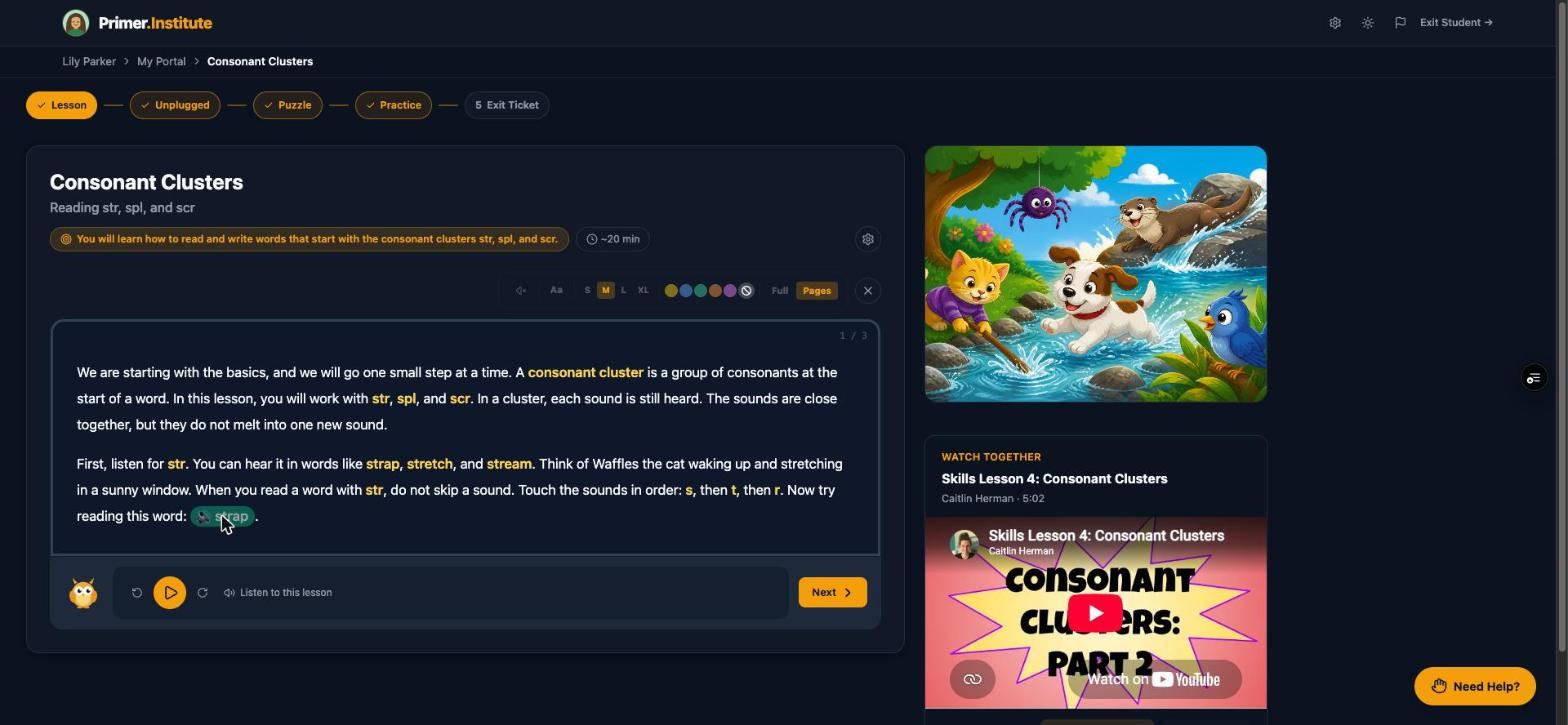
A lesson passage with a sound-out word chip the student can tap
What actually helps

The reading research is unusually clear, and it points in the same direction at every stage.

Each of these rests on learning science that has been replicated for decades. The studies, in plain language, are on the research page.

1

Teach the code explicitly, one pattern at a time

Closed syllables, consonant clusters, vowel teams. A beginning or struggling reader needs each pattern taught directly, practiced on real words, and brought back later. Retrieval beats rereading, and spaced practice beats cramming, across hundreds of experiments.

2

Give them a reason to read the passage

Material connected to a student's own interests raises both engagement and achievement, with the largest gains for students who struggle most. A reluctant reader who gets a passage about otters and a cat named Waffles reads it.

3

Support without stigma

Read-aloud support improves comprehension, most of all for the students who struggle most, and it works best when it is simply part of every lesson rather than a tool a kid has to ask for.

How Primer handles it

Here is how reading is taught in Primer, from the first closed syllable to a passage about the Declaration of Independence.

A sound-out word chip in a phonics lesson

Phonics lessons that sound the words out

A lesson on consonant clusters like str, spl, and scr marks the matching words in the passage as chips. Tap one and Primer breaks it into its component sounds. It appears automatically on exactly the words the lesson is teaching. A closed-syllables lesson for Lily ended in a worksheet that splits kitten, rabbit, and tadpole into chunks.

Closed syllables worksheet →
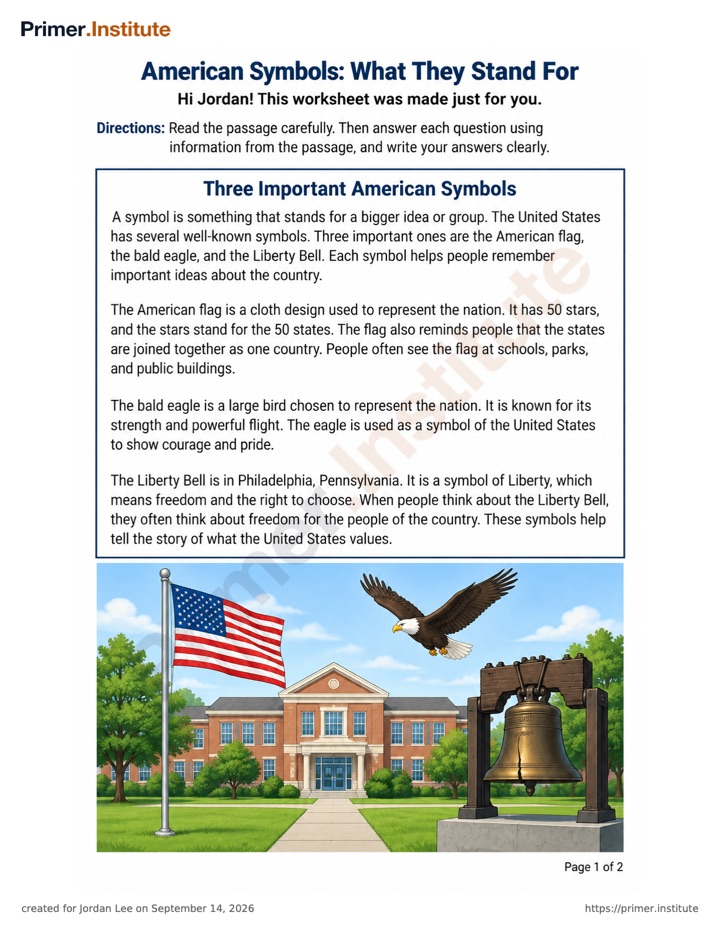
A reading worksheet with a passage about American symbols and seven questions

Passages written for one reader, then questions that send them back to the text

Comprehension lessons pair a passage with questions that point back into it. Jordan read about the flag, the bald eagle, and the Liberty Bell; Alex read how the Declaration was drafted and approved. The passage is at the student's level and about something they chose, and the exit ticket checks whether they understood it.

American symbols reading worksheet →
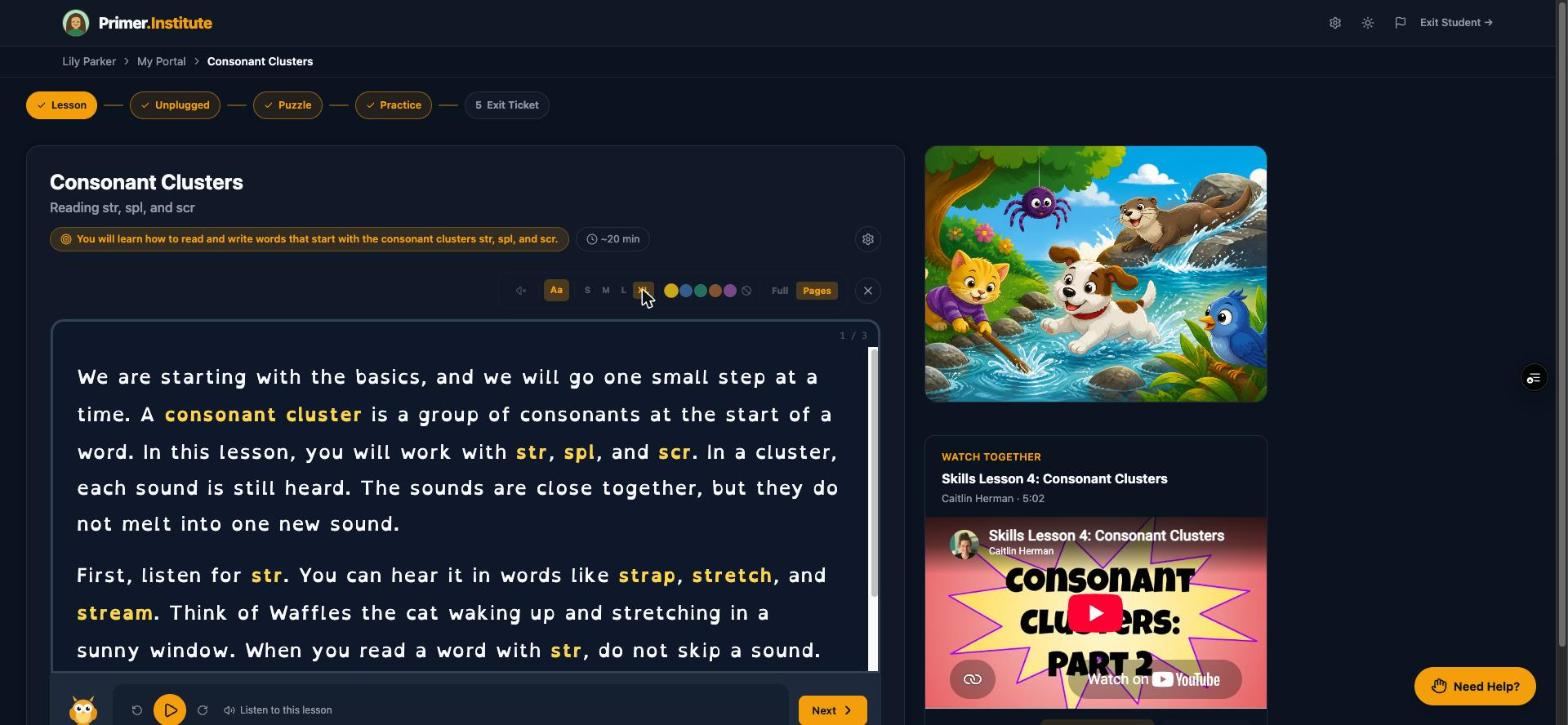
A lesson with the dyslexia-friendly font and larger text applied

Read-aloud, a dyslexia-friendly font, and overlays on every lesson

Listen to this lesson reads the page aloud. The gear icon switches to a dyslexia-friendly typeface, scales text up, and tints the page. None of it is required and all of it is one tap away, in the lesson, the puzzle, and the placement check.

Personalizing the lesson player →
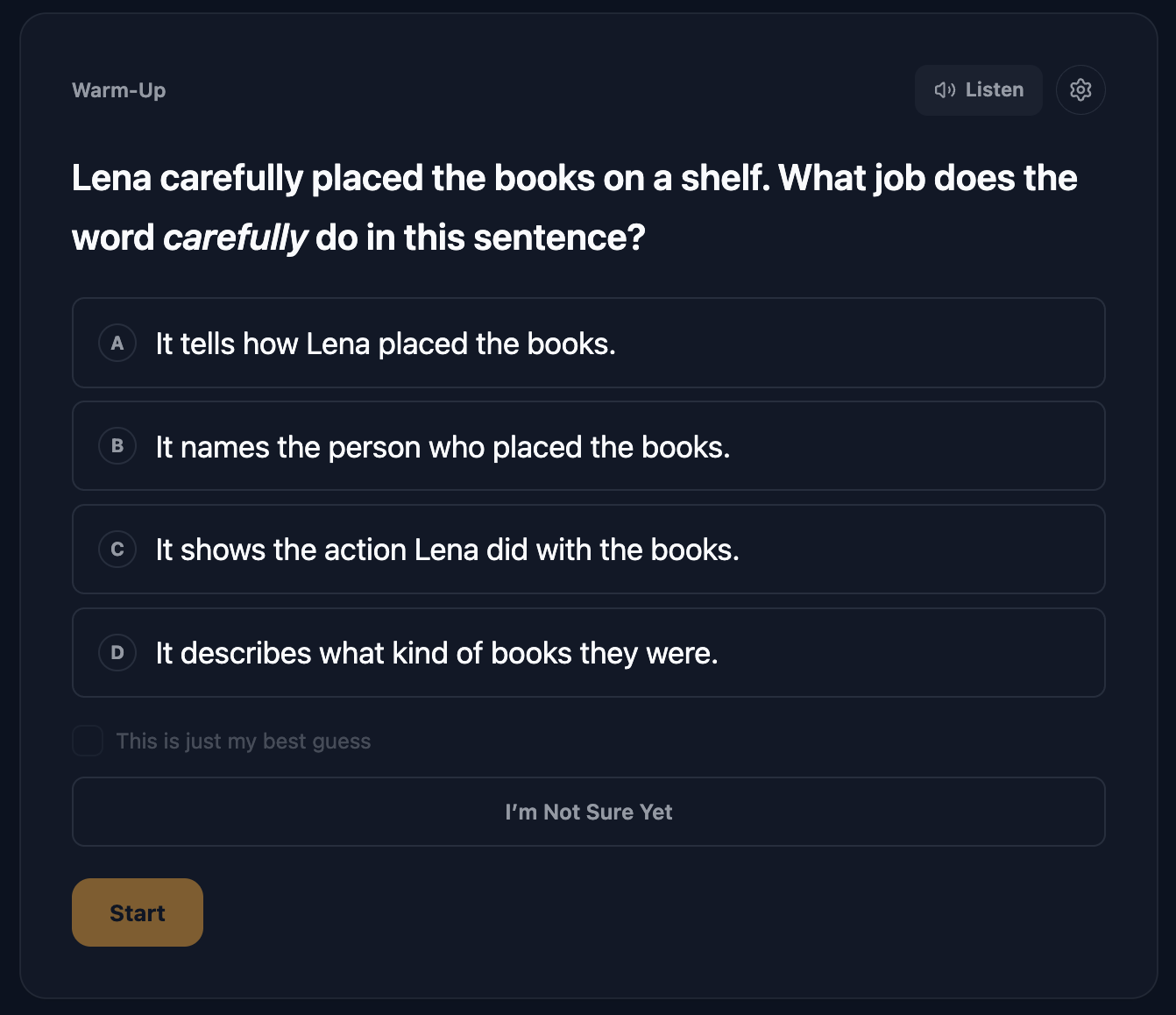
A Starting Point Check question with four choices and an I'm Not Sure Yet button

A placement that hears the word, never shows it

The Starting Point Check finds where a reader should begin. Spelling, phonics, and decoding questions are dictation style: the student taps Hear The Word, and the word is spoken rather than shown. Eighteen questions, no timer, no score shown, and their usual supports on.

The Starting Point Check →
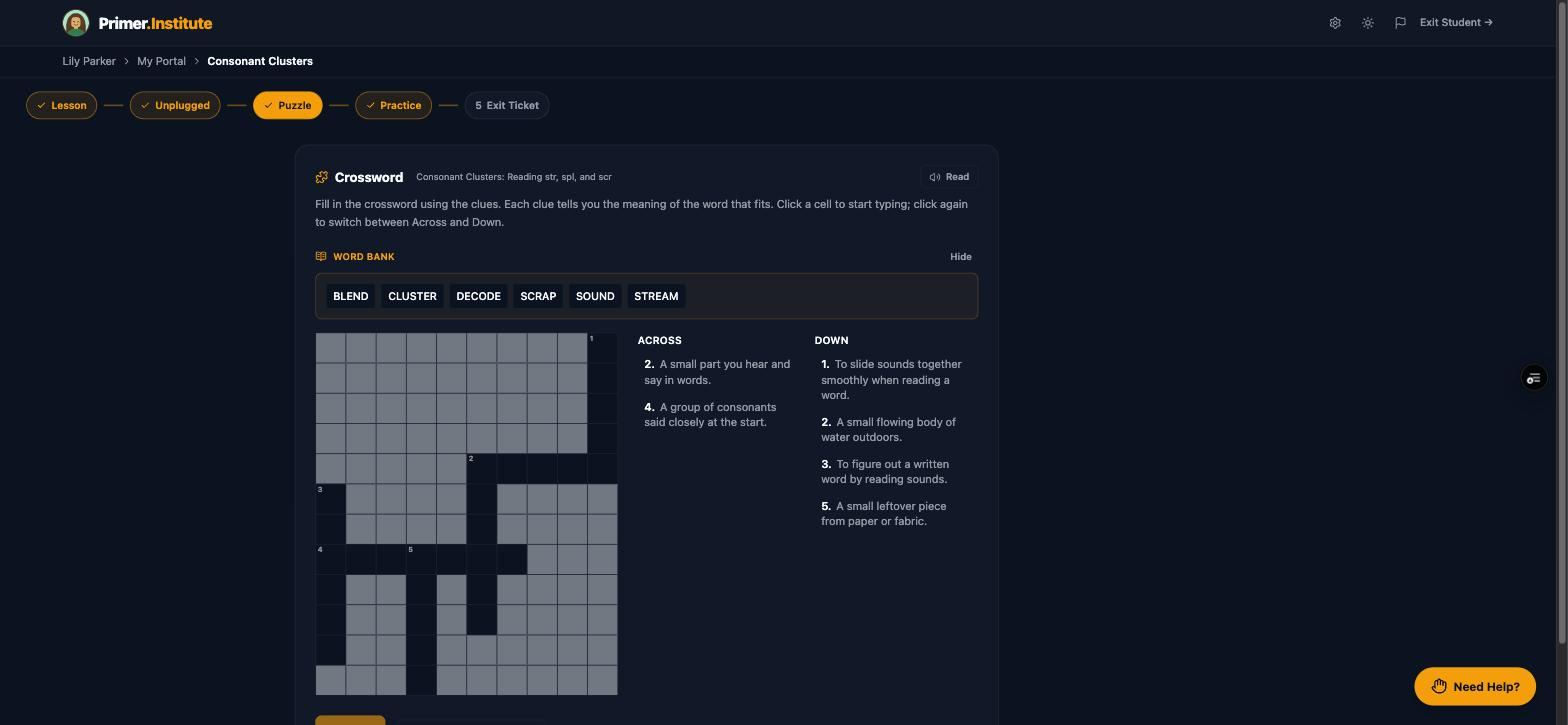
A crossword puzzle built from a lesson's vocabulary

Vocabulary that has to be recalled, not recognized

Every lesson has a Puzzle step built from its vocabulary, often a crossword with clues read aloud, so the new words have to be produced rather than picked from a list. Then five practice questions, then the exit ticket.

Inside a lesson →
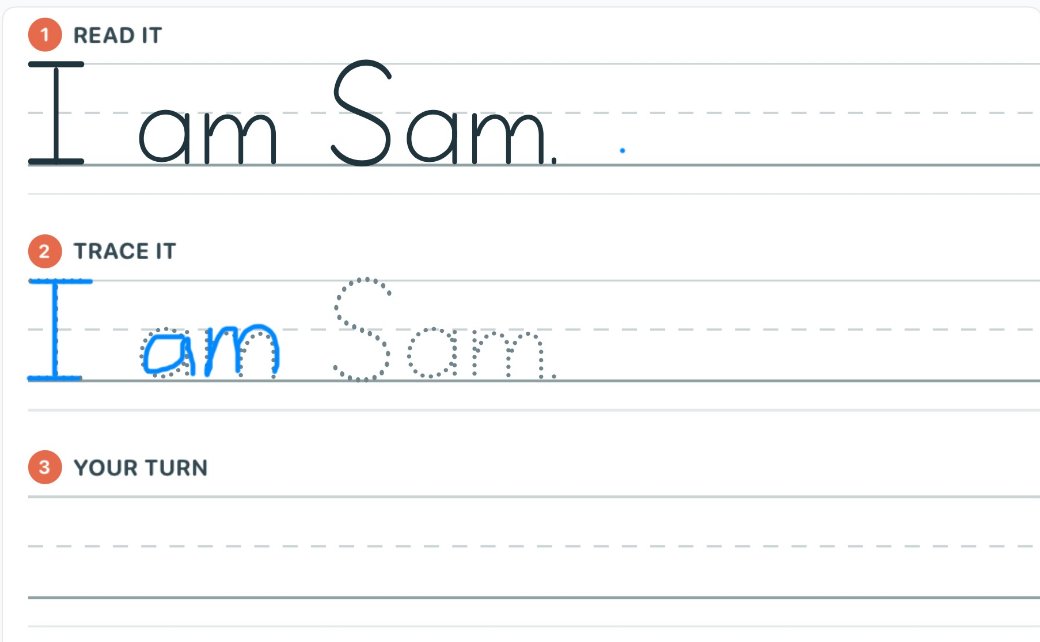
A sentence practice handwriting worksheet: read it, trace it, your turn

Grammar and handwriting, on the same path

Subject and predicate, conjunctions and prepositions, capitals and end punctuation, all taught as lessons with worksheets written around the student. Handwriting pages are generated from the letters they are shaky on, with stroke-order animations, and are measured letter by letter on an iPad.

Handwriting practice →
Getting started

Set it up once. It adapts from there.

  1. Try one free lesson first. A first name, an age, one thing they love, and one topic. No account. The lesson opens on your screen in a minute or two.
  2. Tell Primer about them. Five to ten minutes at intake on what they love, where they get stuck, what has helped before, and what you want them to master.
  3. Let them find their starting spot. Offer the Starting Point Check on each subject, or pick the starting unit yourself, then generate the first batch.
  4. Read the week. A written summary lands every week, with the numbers behind it a click away, and a teacher you can email.
$40 per student, per month
  • Full K through 12 curriculum
  • About 100 lessons a month
  • Read-aloud and dyslexia-friendly mode
  • Weekly parent progress summary
  • 14-day free trial, cancel anytime
Start Free Trial
Questions parents ask

Before you decide

Does Primer teach phonics?

Yes, as sequenced lessons on specific patterns: closed syllables, consonant clusters, and so on. Phonics lessons mark the matching words so the student can hear them sounded out, and the worksheet that follows practices the same pattern on real words.

My child can decode but does not understand what they read. Does this help?

Comprehension lessons pair a leveled passage with questions that send the student back into the text, then an exit ticket that checks understanding. Reports show which kinds of questions they tend to miss, which is usually the most useful thing to know.

What about a child who refuses to read?

The passage is about something they chose at intake, which changes the refusal more than any encouragement does. Read-aloud is there for the days reading itself is the obstacle, and the Unplugged step and worksheet give them a way to show what they learned off the screen.

Is this aligned to ELA standards?

Optionally. Intake lets you check lessons against Common Core ELA or your state framework, and every rung on a reading path shows its typical grade level.

See what a lesson written for your kid looks like.

One free lesson, no account: their name, one thing they love, and one topic. Or start a free trial and let them find their starting spot.