
Catching up

My Child Is Behind. Where Do We Start?

The report card says fourth grade. The kid in front of you cannot do third grade fractions, and nobody can tell you which part of third grade went missing. Catching up is not about going faster. It is about finding the exact rung that is missing and teaching that one. A short Starting Point Check measures where their understanding is solid, so the lessons start right at the gap.

A Starting Point Check finds the gap Start a grade or two below Nothing expires Mastery, not a streak
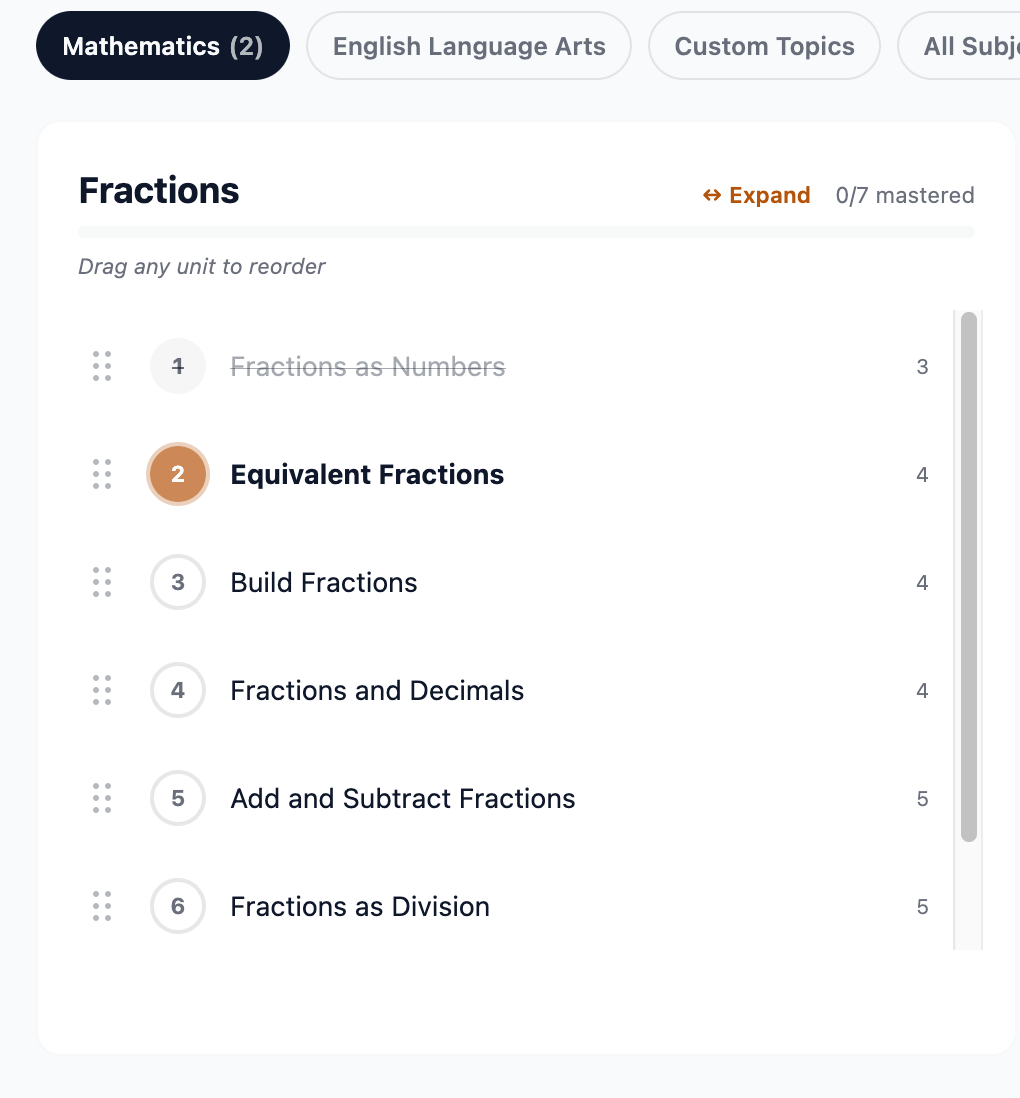
A Fractions path with lesson one mastered, lesson two current, and the grade level on every rung
What actually helps

Students who are behind are the ones the research is clearest about, and the finding is encouraging.

Each of these rests on learning science that has been replicated for decades. The studies, in plain language, are on the research page.

1

The biggest gains go to the kids who struggle most

That pattern shows up across interest-based learning, read-aloud support, and mastery learning alike. Mastery learning in particular averages half a standard deviation of gain, with the strongest effects for the weakest students. Being behind is not a trait. It is a missing rung.

2

Measure the floor before you build

A student who is lost in fifth grade fractions is usually missing something from third grade. Starting at "grade 5" guarantees a wall; starting at the beginning guarantees boredom. The right start is the first thing they cannot do yet, and that has to be measured, not guessed.

3

One-on-one, every lesson

Adaptive tutoring that adjusts to each student's gaps raised scores by about two thirds of a standard deviation. The reason a tutor works is that someone sits down with the student in front of them, and that is the thing a classroom of thirty can never do.

How Primer handles it

Here is how Primer finds the gap and closes it, without a single lesson the student has to be fetched for.

The panel asking where a student should start, with a Starting Point Check offered

A placement check that finds the edge

Offer the Starting Point Check on any subject. Eighteen adaptive questions in four short parts, usually ten to fifteen minutes, no timer. The questions climb until Primer finds where the student's solid ground ends, then the starting unit is set just past it and everything below is marked Tested Out. You see every question, what they picked, and the likely mix-up behind each miss.

The Starting Point Check →
A Fractions path with grade numbers down the right side

Read the ladder and see the missing rung

Every skill is a ladder of lessons with the typical grade level on each rung. Fractions runs 3, 4, 4, 4, 5, 5. Open any rung and the decisions are yours: Mark mastered for what they already have, Start here now for the one they are on, Skip for what does not belong.

Skills, paths, and curriculum →
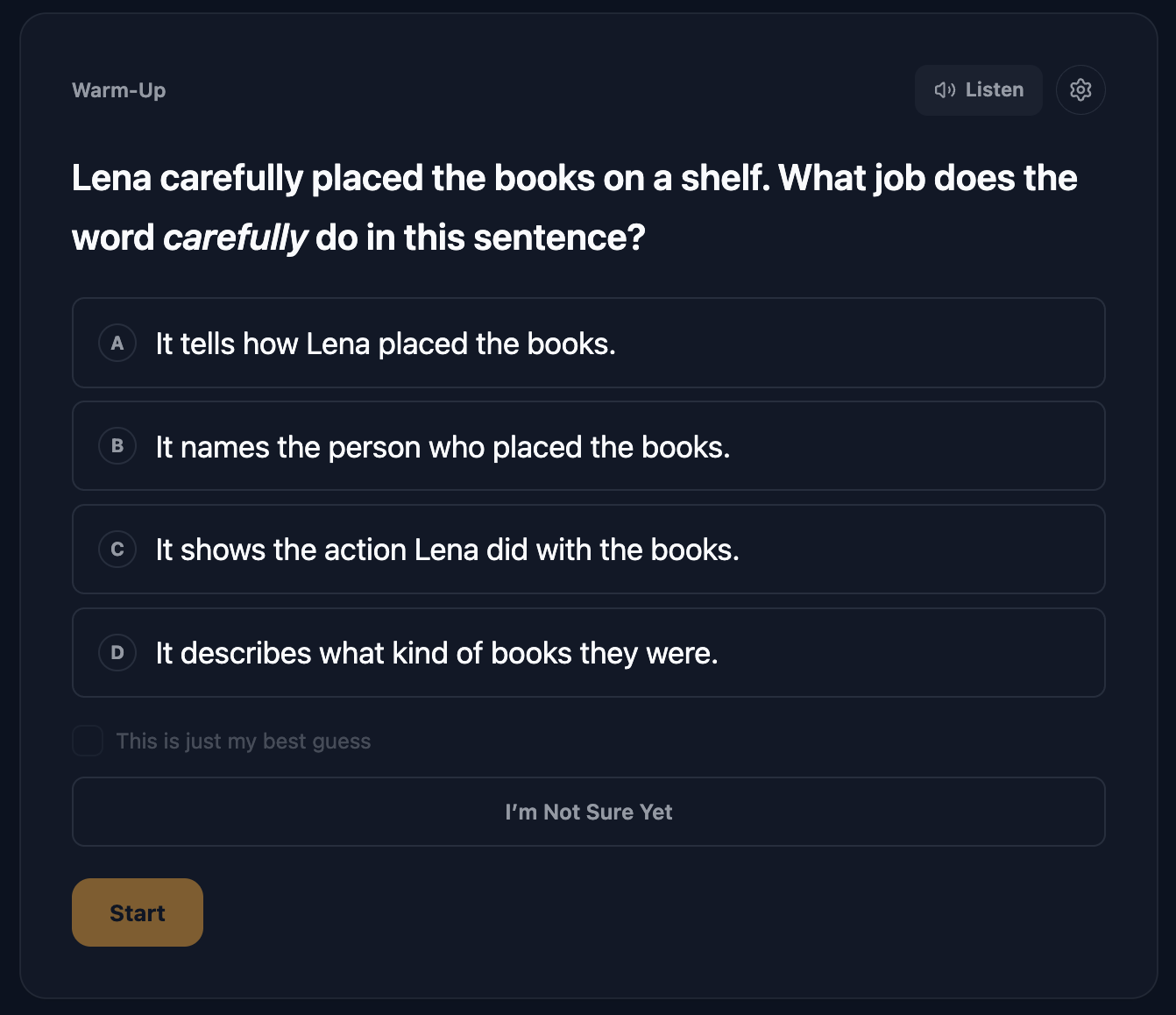
A placement question with an I'm Not Sure Yet button

A safety net if the start is wrong

If the student scores under half on either of the first two graded lessons at a new starting point, Primer puts the tested-out units back and moves the start down, and the report says so under We Moved The Starting Point Back. A placement is a starting point, not a verdict.

Why the check is built this way →
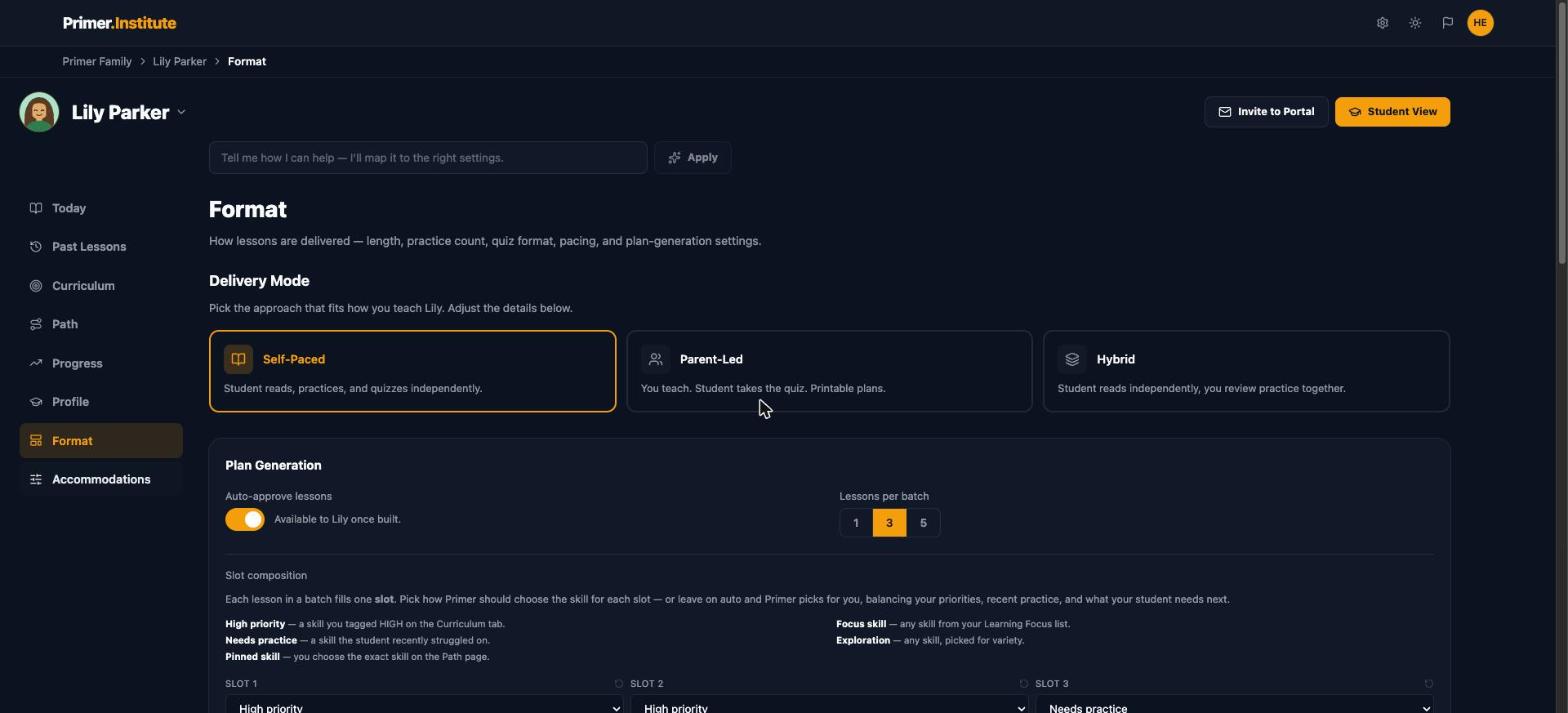
The Format tab with Plan Generation set to a small batch

Three lessons a week, and a missed week resets nothing

Set the batch to three lessons and work the ladder. Nothing expires. Lessons stay queued where they were, and the useful thing after a gap is one short lesson, not a catch-up marathon. A summer of math, in order, is three or four skills, the units they already have marked mastered, and a batch of three.

Building a weekly routine →
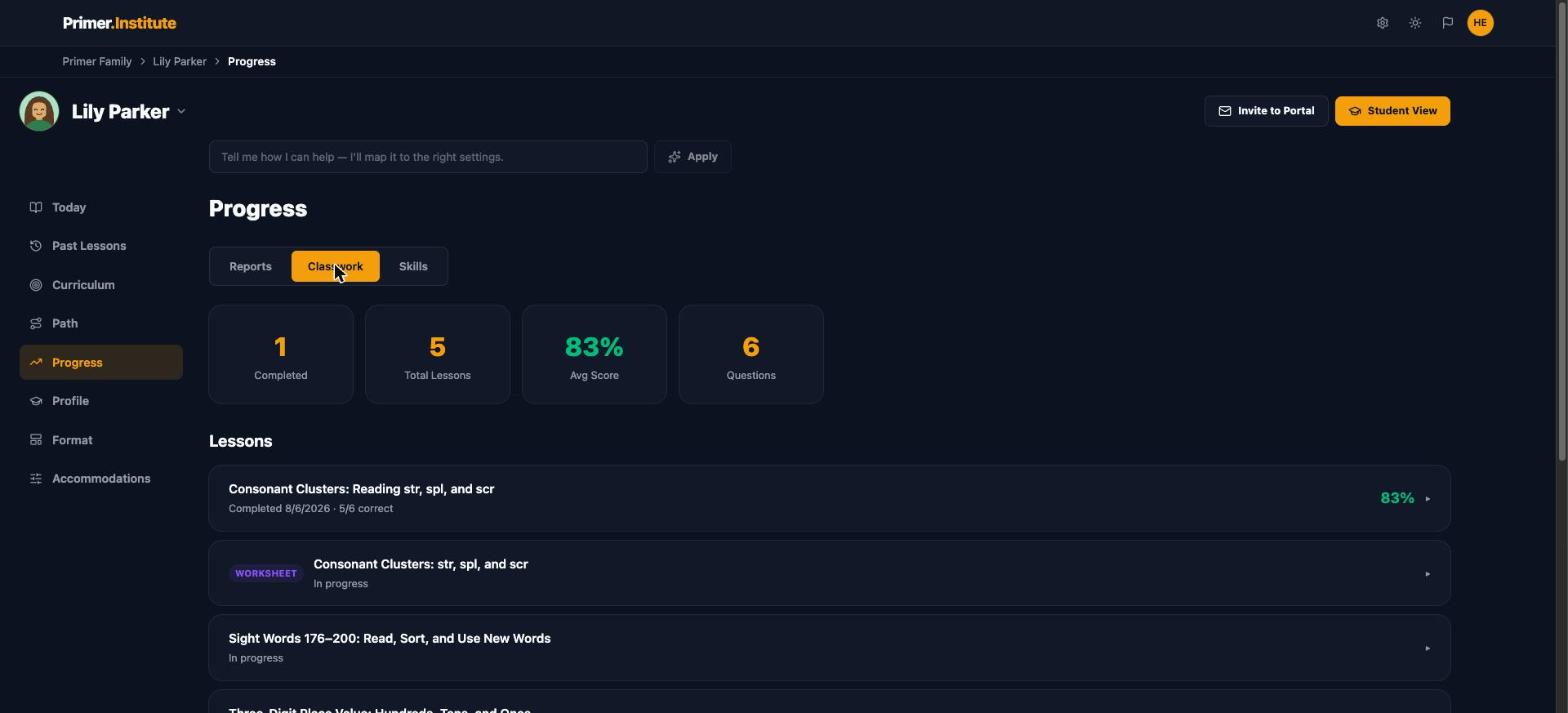
The Classwork tab with completed lessons, average score, and question counts

Mastery that forgives a rough month

Each exit ticket moves the skill's mastery number, weighted toward recent work, so a rough September does not hide a strong November. One bad day is a dip, not a collapse. Primer calls a skill mastered after three consistent exit tickets, and the Skills by Mastery report floats the weakest skills to the top so you know what to watch.

How Primer measures progress →
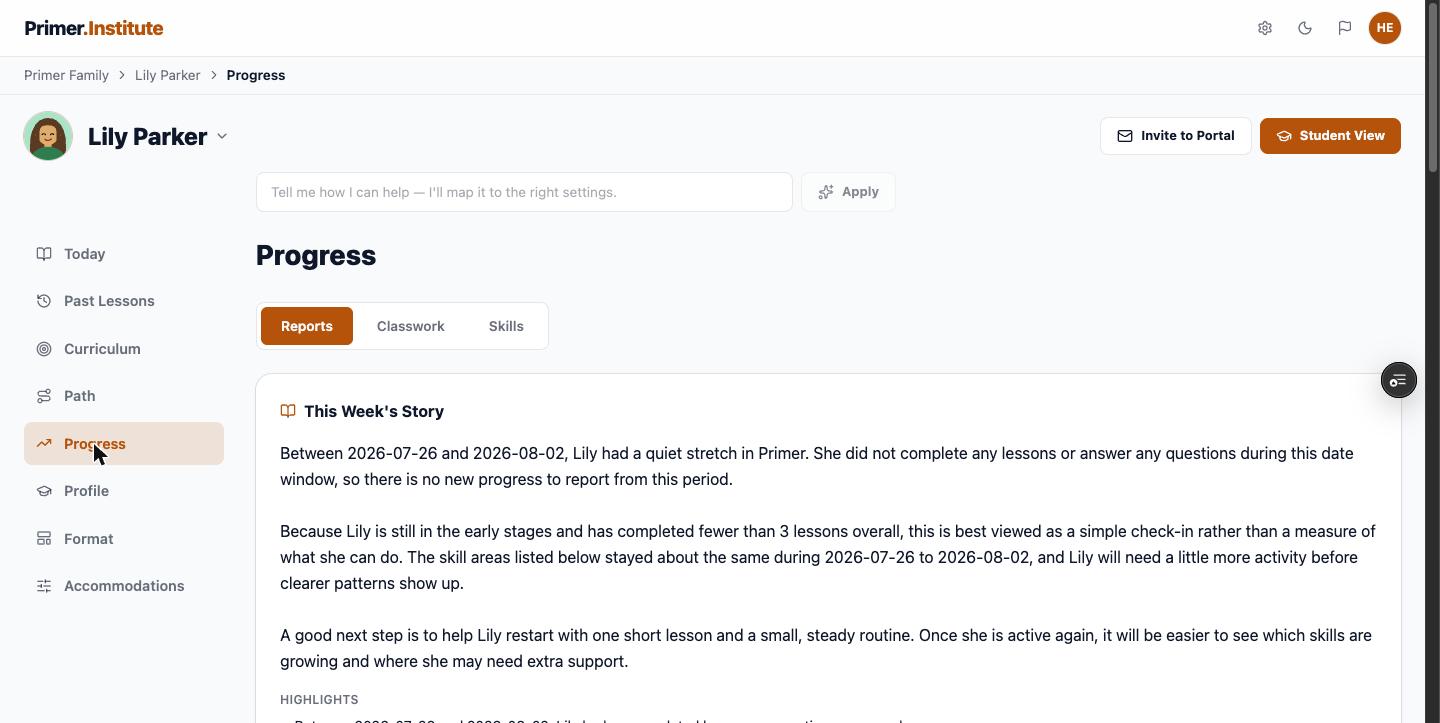
The Reports tab with This Week's Story, Highlights, and Next Steps

A written summary of the week, and a teacher to email

This Week's Story is a plain-English narrative of what happened, rewritten whenever there is new work, with Highlights and Next Steps underneath. Every student has a named Primer teacher with an email address; write to ask for extra practice on one thing or an honest read on how it is going.

Emailing your student's teacher →
Getting started

Set it up once. It adapts from there.

  1. Try one free lesson first. A first name, an age, one thing they love, and one topic. No account. The lesson opens on your screen in a minute or two.
  2. Tell Primer about them. Five to ten minutes at intake on what they love, where they get stuck, what has helped before, and what you want them to master.
  3. Let them find their starting spot. Offer the Starting Point Check on each subject, or pick the starting unit yourself, then generate the first batch.
  4. Read the week. A written summary lands every week, with the numbers behind it a click away, and a teacher you can email.
$40 per student, per month
  • Full K through 12 curriculum
  • About 100 lessons a month
  • Read-aloud and dyslexia-friendly mode
  • Weekly parent progress summary
  • 14-day free trial, cancel anytime
Start Free Trial
Questions parents ask

Before you decide

My child is two grades behind. Will Primer start them that low?

It starts them wherever the Starting Point Check finds solid ground, which can be well below the grade on their report card. The student never sees a grade label or a score, only the name of the unit they are starting on, and the lesson is still written around the things they love at the age they are.

Can I use Primer just to catch up in one subject while we keep our other curriculum?

Yes. Switch on one skill, or one subject, and nothing else. Primer runs alongside school or another curriculum, and the tutoring page walks through exactly that setup.

How will I know the gap is actually closing?

Per-skill mastery, weighted toward recent work, with a confidence number that says how much evidence sits behind it. Mastery charts plot each skill week by week, and Primer does not call a skill mastered until three consistent exit tickets agree.

What if my child shuts down when something is hard?

The placement never shows right or wrong, has an I'm Not Sure Yet button, and starts one step below where the student is expected to be so the first part usually goes well. In lessons, a Need Help? coach is on every step, and intake asks what frustration looks like for this student and what helps.

See what a lesson written for your kid looks like.

One free lesson, no account: their name, one thing they love, and one topic. Or start a free trial and let them find their starting spot.