
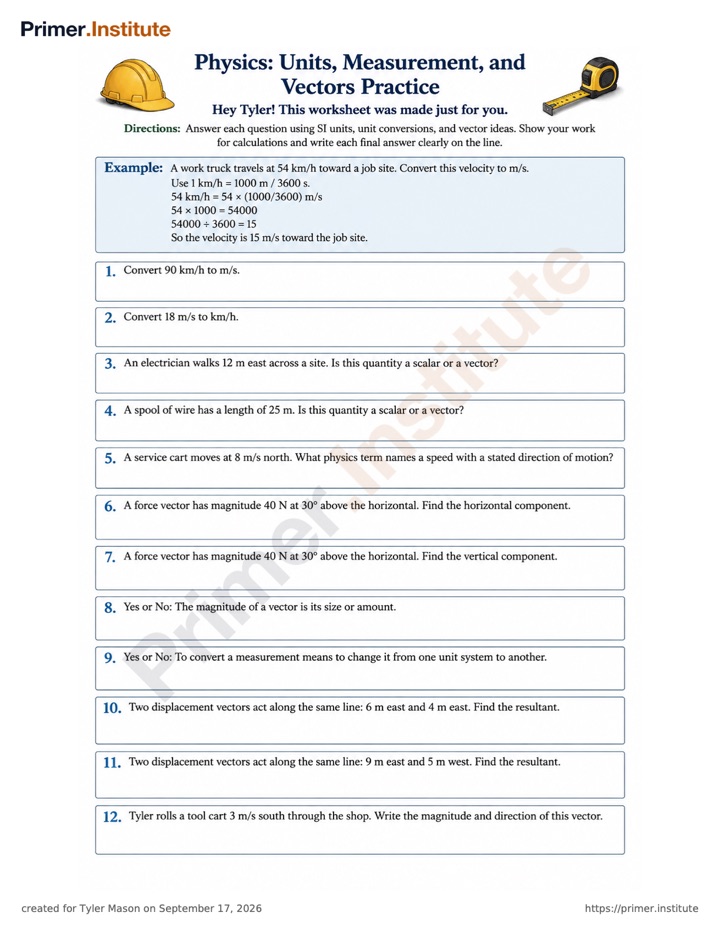
Physics: Units, Measurement, and Vectors Practice
Made for Tyler, set on a job site
Twelve problems from the first unit of a physics course, every one of them set on a job site. Tyler converts a work truck's speed from km/h to m/s, decides whether a spool of wire's length is a scalar or a vector, splits a 40 N force at 30 degrees into its components, and adds displacements along a line.
Skills on this worksheet
- Convert between km/h and m/s
- Tell scalars from vectors, and speed from velocity
- Resolve a force at an angle into horizontal and vertical components
- Add collinear displacement vectors to find a resultant
- State a vector by its magnitude and direction
Question types: Calculations, scalar-or-vector sorting, yes or no on definitions, and short written answers.
Three of the questions
- Convert 90 km/h to m/s.
- A force vector has magnitude 40 N at 30° above the horizontal. Find the horizontal component.
- Two displacement vectors act along the same line: 9 m east and 5 m west. Find the resultant.
The answer key gives the answer to every question and, for the worked example at the top, the reasoning behind it.
How it was personalized
Tyler wanted his physics set on a construction site, so the problems are about work trucks, electricians crossing a site, spools of wire, and tool carts, with a hard hat and tape measure at the top of the page. The physics is a standard introductory unit; the setting is the one he asked for.
A real lesson, a real student
Every Primer lesson has an Unplugged step, and any lesson can turn into a printable worksheet with one tap. This one came out of Tyler's lesson on the same topic, so the questions check exactly what the lesson taught, in the words the lesson used. Names, interests, and the illustration come from Tyler's profile.
Fill it out on paper, or on an iPad with Apple Pencil, where it is graded letter by letter. How worksheets work in Primer.
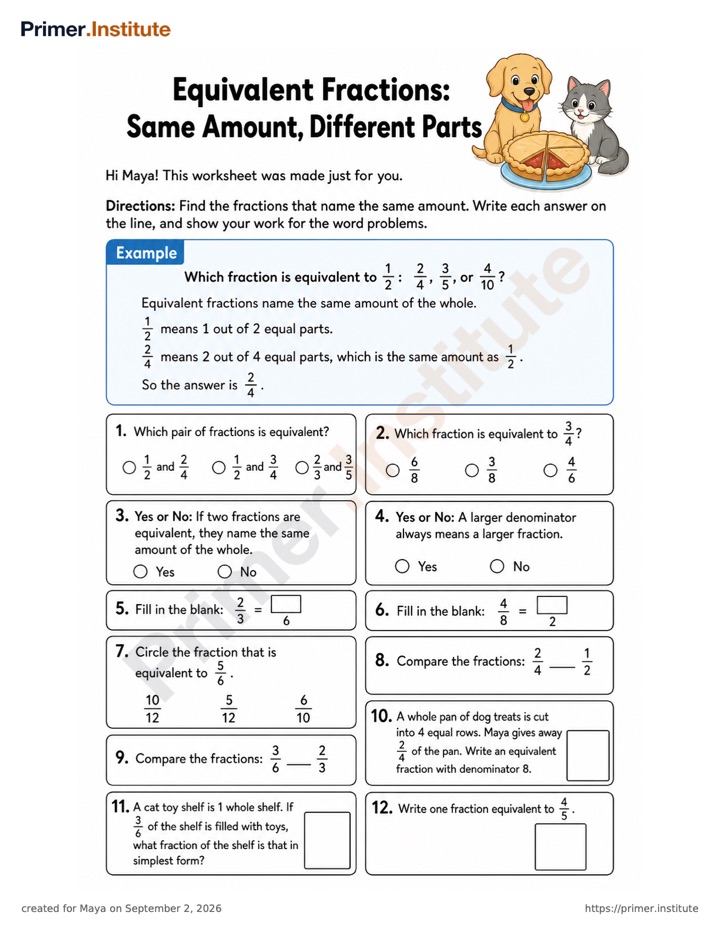
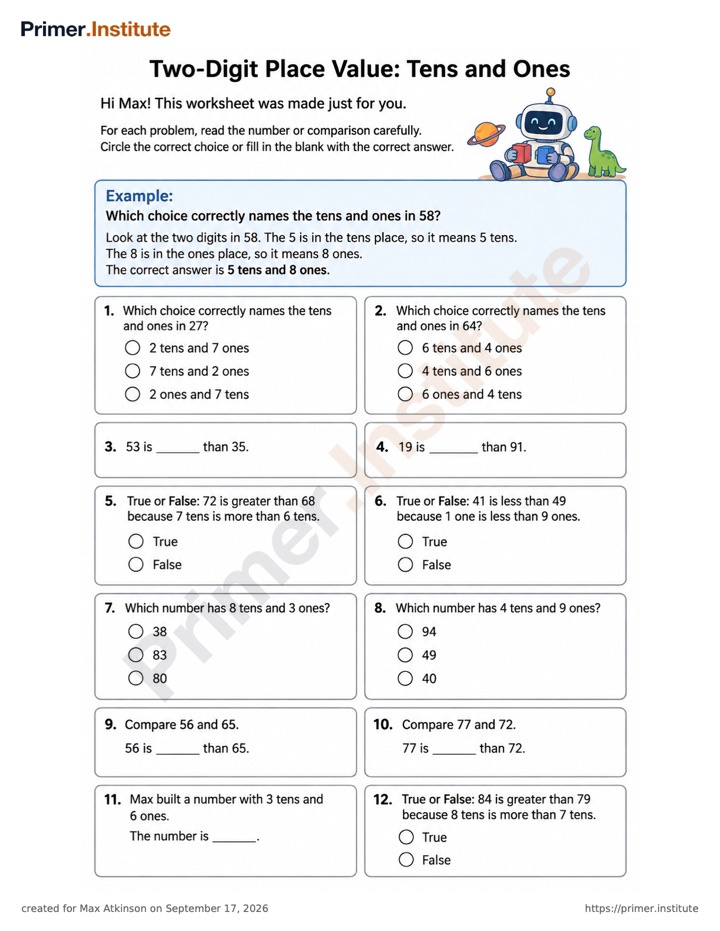
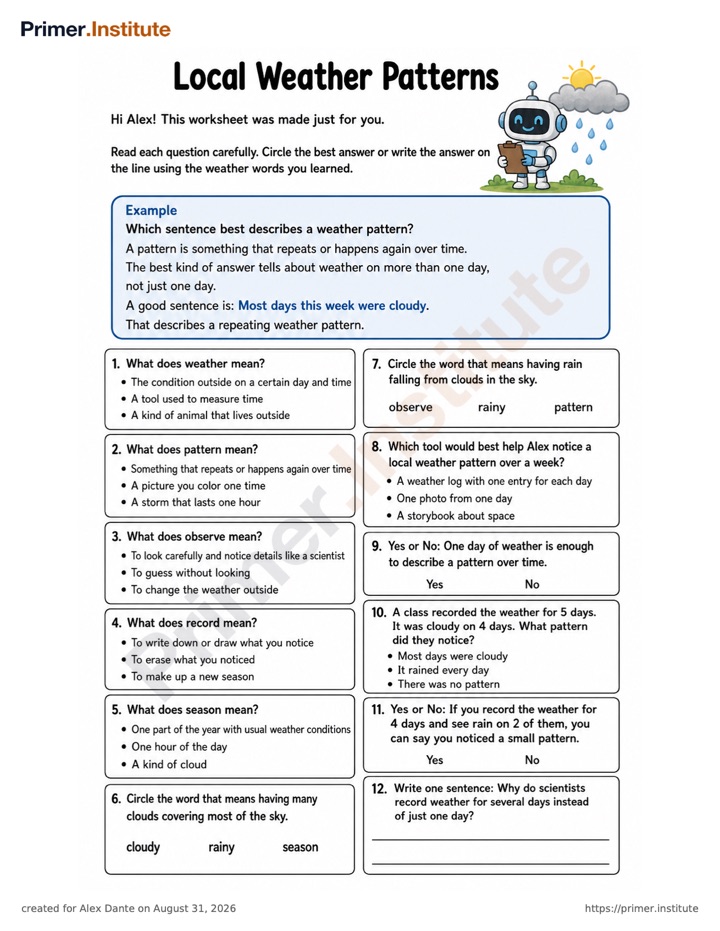

Get one with your student's name on it.
Every Primer lesson ends with a worksheet like this one, written for your student and their interests. Try a single free lesson with no account, or start a free trial.