
Lessons Taught From Your Family's Worldview
Every family teaches from somewhere. Primer lets you say where, for each student, and keeps religion out of the lessons entirely unless you ask for it.

Most curricula make this choice for you. A secular program leaves faith out of the story of the world. A faith-based program weaves one tradition through every subject. Either way, the decision was made before your family arrived, and it applies to every student the same way.
Primer makes it your decision, one student at a time. A single question in the intake interview asks whether lessons should be taught from a faith-based worldview. Answer it, and the teacher that writes your student's lessons knows what your family believes. Leave it alone, and nothing religious shows up at all.
Secular by default
Unless you choose a worldview, your student's lessons stay neutral. The teacher is instructed to leave religious content and religious framing out unless a parent has asked for it, and that is a rule it follows on every lesson, not a tone it tries to strike. A science unit on how the Earth formed, a history lesson on the Reformation, a reading passage set at a holiday: all of it is written without a faith perspective until you set one.
That is the Primer most families start with, and for many of them it is the right one to stay on.
One question, one student at a time
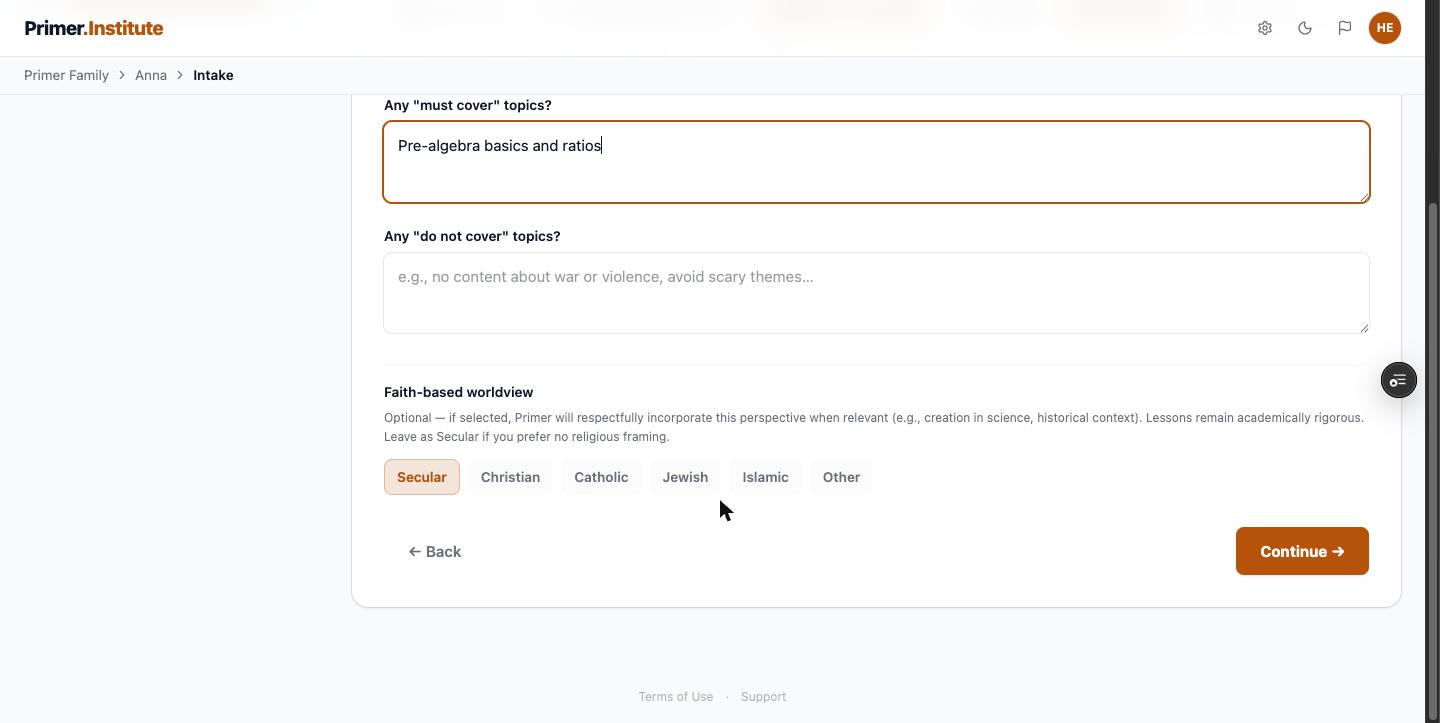
When you add a student, the intake interview walks through who they are, what they love, where they stand, and how they learn. The Goals step ends with Faith-based worldview. Secular is already selected. The other choices are Christian, Catholic, Jewish, Islamic, and Other, and Other opens a box where you describe the tradition in your own words: Hindu, Buddhist, non-denominational Christian, Orthodox, whatever fits your family.
The answer belongs to the student, not the account. If one child is set to Jewish and another is left Secular, each gets lessons written that way.
What changes, and what doesn't
Choosing a worldview does not swap the curriculum for a religious one. The skills, the sequence, the five-step lesson shape (Lesson, Unplugged, Puzzle, Practice, Exit Ticket), the worksheets, and the standards you asked for all stay exactly as they were. Fractions are still fractions.
What changes is the framing, wherever framing is relevant. The teacher is told to bring the worldview in respectfully when a topic touches it: origins in science, historical context, the moral themes in a story. It is also told to keep every lesson academically rigorous and to present the faith perspective alongside the factual content, never in place of it. A Christian student learning about the age of the universe still learns what the evidence shows. The lesson also makes room for how their family understands creation.
Take the lesson from this month's newsletter. Its objective is to explain why winter days get shorter and to describe how several cultures use light in seasonal celebrations. The science half reads the same for every student: a tilted Earth, a solstice, a long night. The second half is where the worldview shows.

Christian
Advent candles, the Christmas star, and Christ as the light of the world.

Jewish
Hanukkah, the menorah, and the story of the oil that lasted eight nights.

Hindu, by way of Other
Diwali, rows of diya lamps, and the triumph of light over darkness.
The shared version of that lesson, the one anyone can play without an account, shows the traditions side by side, because it was written for everyone at once. A lesson written inside your student's account is written for one family.
 A tip for parents
The Other box is free text, and the teacher reads it word for word. "Reform Jewish" or "Eastern Orthodox" gives it more to work with than "other," so be as specific as your family would be.
Changing your mind
The setting lives in the student's intake record, and the teacher reads that record fresh every time it writes a lesson. Change the answer and the next lesson follows it. Nothing already in the student's history is rewritten, so a change is never a reset: the memory of everything they have done stays put, and only the framing moves.
Where to find it. The question is on the Goals step of the intake interview, which the Adding a New Student help article walks through screen by screen. The "do not cover" box on the same step is the place for anything you want left out of lessons altogether, whatever the worldview.
Your school, your call
Primer was built by parents who wanted a school shaped around their own children. What a family believes is part of that shape, and it is not something a curriculum should decide on your behalf. Pick the worldview that fits yours, or none at all, and change it whenever you like.
Every plan starts with a 14-day free trial, and the worldview question is waiting on the first student you add. If you would rather see a lesson before setting anything up, the first one is free with no account and no card.